
The One Document That Stops Clients From Comparing You to Everyone Else
AI just made the comparison problem worse. That's not an exaggeration.
Every agent who used to have weak positioning now has a tool that generates polished bios, professional emails, and client-facing copy in about four minutes. The gap between someone who can write and someone who can't has effectively closed. Which means the thing that used to make generic competitors easy to dismiss is gone.
Your competition doesn't just sound more put-together now. They sound more like you. And if your positioning isn't built on something genuinely specific to how you work and who you work with, a client scrolling through their options has very little reason to land on you over anyone else.
You're good at what you do. You've got the track record, the experience, the results.
And you're still losing deals to people who aren't as good as you. Fun.
The person who won that deal probably wasn't more qualified. They were just more specific about who they are and how they work, and that specificity reached the client before you did. Your positioning didn't do the job it needed to do before you got on the phone.
There's a fix. It's one document. And once you have it, the comparison problem mostly goes away.

Why Clients Compare You to Everyone Else in the First Place
Clients compare salespeople on price when they can't tell them apart on anything else. That's the whole situation, right there.
When every agent, consultant, or advisor in your space says the same things — "I work hard for my clients," "I have 15 years of experience," "I'm committed to getting you results" — the only thing left to compare is the number at the bottom of the proposal. Clients aren't doing this to be difficult. You just haven't given them anything else to grab onto.
Your bio, your working with me conversation, your intro email — if all of it sounds like what everyone else is saying, clients treat you like a commodity. Because that's what your messaging is telling them you are.
Your skills aren't the issue. Your marketing just isn't translating them into something a client can understand before they decide.
What Actually Makes Clients Choose You Before You Even Talk
Here's the part most sales training completely skips over.
The decision to work with you usually happens before the first real conversation. Clients Google you. They look at your website, your LinkedIn, your bio. They're trying to figure out, before they spend 45 minutes on a call with you, whether you're even worth their time.
And in that research phase, most sales professionals look identical.
What actually tips the decision is whether a client can answer one question before they hire you: "Why this person, specifically?" Not "they seem fine" or "they have good reviews." A specific reason.
That's what good positioning does. And the fastest way to make it usable is a single document — often called a "working with me" document — that answers the comparison question before it's even asked.
What Is a Working With Me Document?
It's a one or two-page client-facing document that explains, in your own voice, how you work, who you work best with, and why the way you do it matters.
Think of it less like a resume or a pitch deck and more like a conversation starter that does the heavy lifting before you show up. Done right, it does four things:
It pre-sells your process. Clients understand what they're getting before they ask.
It filters wrong fits. The people who aren't right for you opt out before you waste time on a call with them. This sounds like a loss. It's actually a gift.
It reframes the comparison. You're no longer being stacked against competitors on price. You're being evaluated on fit — a completely different conversation.
It builds trust before you've earned it. The specificity of the document signals that you actually know what you're doing. Generic positioning signals the opposite.
Not sure where your positioning is breaking down right now?
Grab the free Pre-Sale Positioning Checklist. Ten questions that show you exactly where clients are slipping away before you get a chance to close them.
Download the free checklist here [YOUR LINK]
Why Most Sales Professionals Don't Have This (And Why That's Fixable)
Most sales training focuses on what to say on the call. How to handle objections. How to close. How to follow up without being annoying.
All of that matters. But it assumes the client walks onto the call already warm, already interested, already tilted slightly in your favor. What happens when they don't? When they've talked to three other people before you? When you're the third meeting of their day and they're making the exact same decision three times in a row?
You spend the first half of the call re-establishing your credibility, re-explaining your process, re-proving your value. By the time you get to the actual conversation, you're already behind.
The working with me document solves the before-the-call problem. It does the positioning work so you don't have to redo it every single time, with every single person, from scratch.
What Goes In the Document (And What Absolutely Doesn't)
This is where most people go wrong when they try to build something like this on their own. They make it about themselves. Their credentials. Their years in the industry. Their awards. Their very impressive list of certifications that nobody asked about.
That stuff doesn't make a client feel anything. It just confirms you're qualified, and everyone they're talking to is qualified.
What actually belongs in this document:
Your specific process. Not "I work hard for my clients" but what actually happens from the moment someone hires you to the moment they get results. Specific steps.
Who you work best with. The specific type of client, situation, or problem you're actually built for. Not "anyone who needs help buying or selling."
What makes your way different. A specific, verifiable reason why the way you work produces better results for a particular kind of person.
What they can expect from you. Communication style, timeline, what you handle, what you don't. The specifics that make someone feel like they actually know what they're signing up for.
What doesn't belong: your origin story (unless it's genuinely relevant), a list of certifications, generic promises like "I'm committed to your success." Basically anything you couldn't say out loud to a skeptical client and have them actually believe.
How to Use It So It Actually Does Something
Having the document is half the work. Knowing when to deploy it is the other half.
Before the first call.
Send it with your booking confirmation. "Before we talk, here's a quick overview of how I work so we can use our time to figure out if it's a good fit." That's it. Clients arrive informed instead of cold, and the whole tone of the conversation shifts.
In DMs and inquiries.
When someone asks "what do you do?" or "how does this work?" stop typing the paragraph explanation and send the document. It answers the question better than you can in a text message, and it makes you look organized and prepared — which is its own form of pre-selling.
During the comparison conversation.
When a client says "we're talking to a few other people," you say "that makes sense — here's something that might help as you're comparing options." Send the document. You've just given them something concrete to hold while they're deciding, and it's specifically designed to make the case for you without you having to make it out loud.
In follow-up.
If someone goes quiet after your first conversation, the document gives you a reason to follow up that isn't "just checking in" — three words that make everyone cringe on both sides of the message. You're sending something useful. Something that actually moves things forward.
The Difference Between Sales Pros Who Get Chosen and Those Who Don't
Build the Document That Closes the Gap
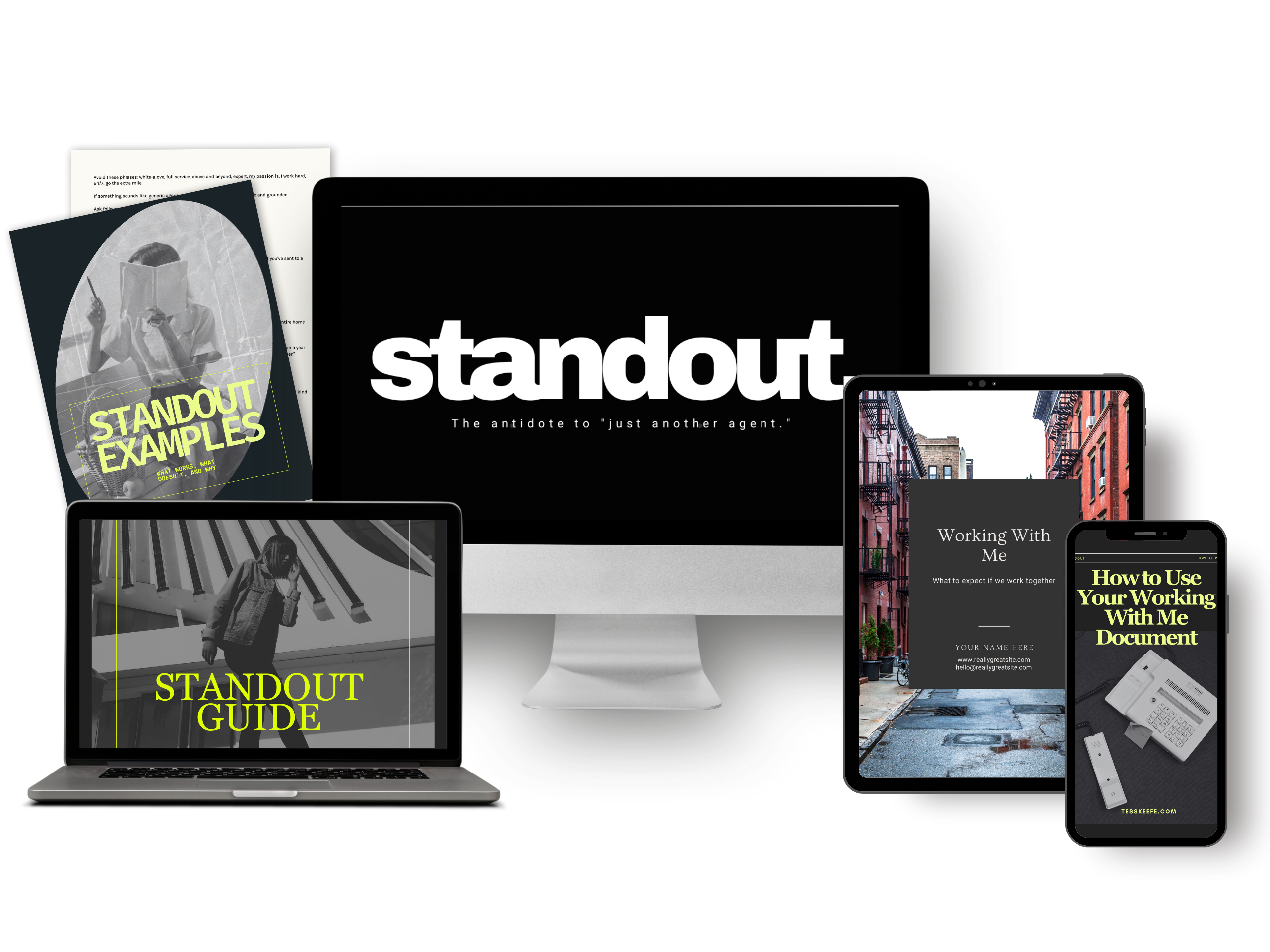
STANDOUT is the framework that walks you through building your own working with me document. The one that answers "why should I choose you?" before anyone asks.
In under an hour you'll have a buyer version and a seller version, in your own voice, ready to use in every DM, consult, email, and follow-up. Build it once. Stop starting from zero every time someone asks why they should choose you.
Get STANDOUT for $37 [YOUR LINK]
You already know how to do the job. This is the part that makes clients choose you for it.
